Species Profile
Harvester Termites
Hodotermes mossambicus
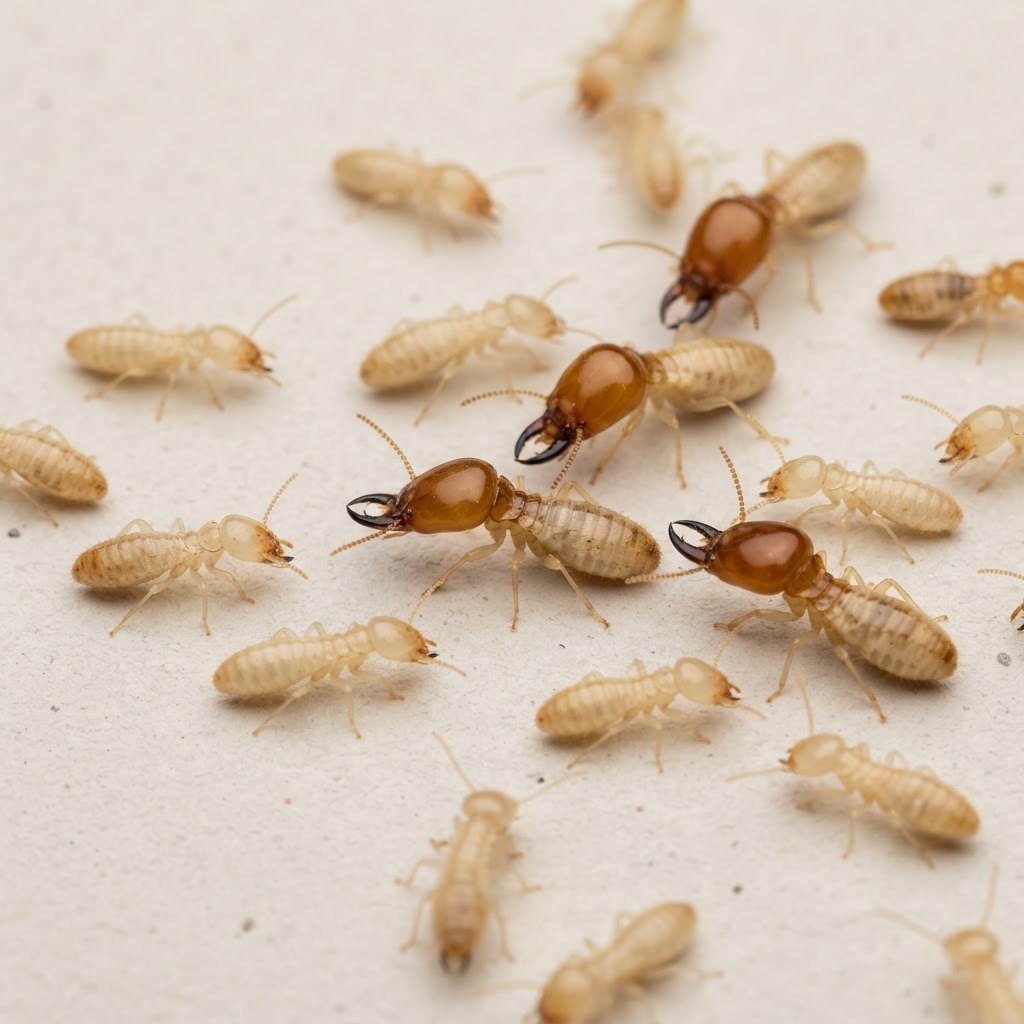
Harvester termites (Hodotermes mossambicus) are subterranean termites common in the Western Cape that forage above ground, collecting grass and plant material to feed their underground colonies. Unlike structural termite species, they do not eat building timber — but they can cause extensive damage to lawns, gardens, sports fields and agricultural land by stripping vegetation bare around their nest entrances. Large colonies can denude significant areas of turf and grassland.
Biology & Behaviour
Harvester termites live in deep underground nests with extensive tunnel systems. Workers emerge at night or on overcast days to forage, cutting and collecting grass, leaves and plant material which they carry back to the nest. They are distinct from destructive structural termites in that they do not consume timber — however, their foraging can strip lawns and gardens bare. Colonies are established by winged alates (reproductive swarmers) that emerge after rain to mate and found new colonies.
Signs of Infestation
Infestation Indicators
Bare, circular patches of dead or stripped grass on lawns
Small soil mounds or holes (foraging holes) across affected turf
Columns of pale termites visible on the surface at night or on overcast days
Grass blades cut cleanly at soil level — harvested by foraging workers
Winged termites (alates) swarming after rainfall — new colony establishment
Clinical Organicism Protocol
Remediation Protocol
The Eco Pestelence 4-phase intervention methodology, calibrated specifically for harvester termites.
Detection
Lawn and garden survey mapping all bare patches and foraging holes. Night-time inspection to observe active foraging columns. Nest location via soil probing and foraging trail mapping.
Isolation
Reduction of thatch and organic debris that provides food source. Lawn health improvement — healthy, well-maintained turf is more resistant to termite foraging. Identification of active foraging routes for bait placement.
Neutralization
Subterranean bait station deployment at active foraging points — slow-acting bait carried back to the nest, eliminating the colony from within. Direct nest treatment with termiticide where nest location is confirmed. Lawn treatment with targeted insecticide during active foraging.
10-Day Elimination Programme
The initial treatment eliminates active pests while eggs continue hatching over the following days — newly hatched pests contact the residual treatment, progressively clearing the infestation within ~10 days.
Shielding
Pre-summer seasonal bait station monitoring. Lawn health programme — aeration, topdressing and irrigation to restore damaged turf. Annual colony activity assessment during peak foraging season.
Eco Commitment
Harvester termites play an important ecological role in breaking down plant material and aerating soil. Our subterranean bait approach targets only problem colonies, allowing beneficial termite populations to continue their ecological function in non-urban areas.
Concerned about harvester termites? Request a professional assessment.
Request Harvester Termites AssessmentBack to EncyclopediaOther Species
 Ants
 American Cockroaches
 German Cockroaches
 Wasps
 Red-headed Cockroaches
 Oriental Cockroaches
 Fleas & Bed Bugs
 All Moths
 Rodents
 Spiders
 Millipedes & Centipedes
 Dune Moles
 Crickets
 Bird Removal
 Snails & Slugs
 Grain & Flour Beetles
 Weevils
 Bat Proofing
 Earwigs
 Mole Crickets
 Silverfish
 Carpenter Ants
 Gecko Control
 Mosquitoes
 General Spray